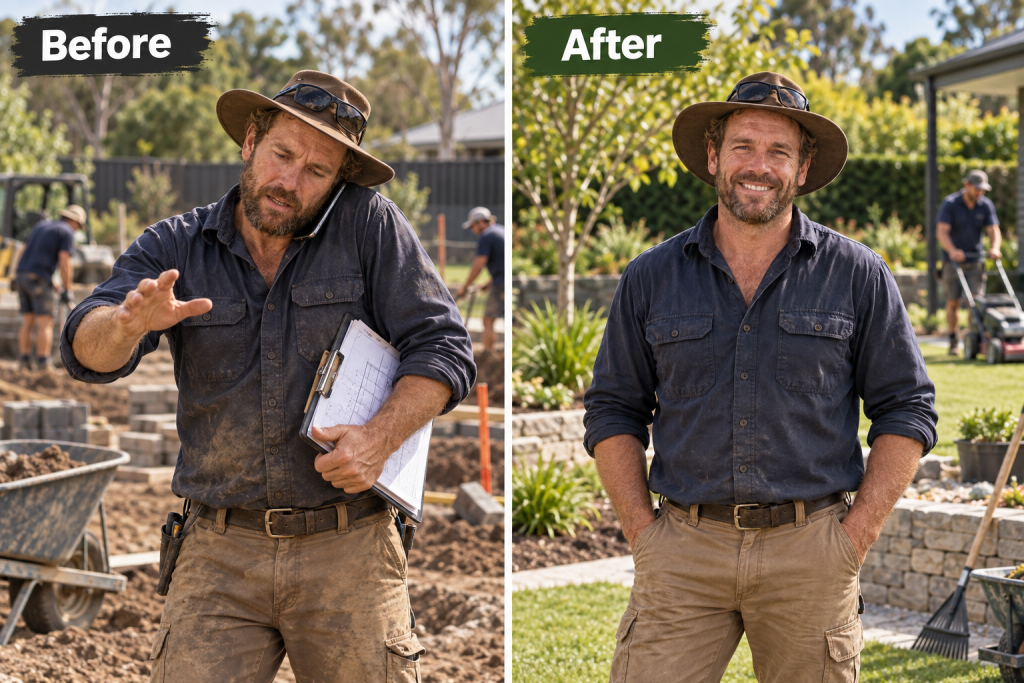
There wasn’t enough time to respond to every enquiry, yet the business couldn’t confidently add more people because its existing way of working was already stretched.
The owner was highly stressed, working long hours and constantly being pulled in different directions. He knew the situation was unsustainable and that something had to change.
The business had outgrown the way it was being run
This is a common stage in the growth of a successful trades business.
The skills, hard work and personal involvement that helped the owner build the business eventually become the very things preventing it from growing further.
When everything depends on the owner, more work doesn’t necessarily create more success. It often creates longer hours, more pressure and a greater risk of important things being missed.
Before we could change how this landscaping business operated, the owner had to accept that the existing model could not continue.
The personal cost had become too great, not only for him, but also for his family.
The biggest change wasn’t just operational
Over six months, we implemented SYSTEMology and began systemising and streamlining the business’s administrative and operational sides.
But the most important transformation wasn’t simply the creation of SOPs or the introduction of new technology.
It was the owner’s shift in mindset.
He had spent years being the person who solved the problems, answered the questions and kept everything moving. Stepping away from some of that work didn’t always feel natural.
Like many trades business owners, he associated being productive with physically “doing”, being on the tools, attending the site or personally completing a task.
That made it difficult to step back.
Guilt is so often attached to not being on the tools, even when that time was being redirected to grow the business: quote larger projects, improve the business, or support the team.
He had to recognise that his role had changed.
The business no longer needed him to be its busiest worker. It needed him to become its owner and leader.
Learning that investment is part of growth
Another important shift was recognising that he didn’t have to do everything himself.
Trying to save money by holding on to every task had created a far greater cost in lost time, missed enquiries, stress and limited capacity.
Sometimes, you have to spend money to make money.
For this business, that meant investing in the right technology, employing administrative support and seeking coaching and specialist advice.
These aren’t unnecessary expenses. They are part of building the infrastructure a growing business needs.
Technology can streamline the work. Systems can make expectations clear. An admin person can take ownership of lower-level tasks. Coaching can help the owner see the business differently and make decisions that are difficult to make alone.
The goal isn’t to spend money for the sake of it. It’s to invest carefully in the people, tools and support that help the business move beyond its current limitations.
What has changed after six months?
After six months of implementing SYSTEMology:
- More than 50 systems across administration and operations have been identified, documented and organised.
- New enquiries are streamlined through one form and automatically created as client cards in ServiceM8.
- Systems are being rolled out across the team, helping people understand what is expected and find answers for themselves.
- An admin person is being employed to take over lower-level tasks that no longer need to sit with the owner.
- The owner has greater control and visibility without needing to be involved in everything.
- The business now has a system for systemising, allowing this work to continue beyond our initial engagement.
- The owner has more time to focus on larger quotes, business growth and his family.
The change hasn’t happened overnight, and there is still more work to do.
Systemising a business is not about writing a collection of SOPs and considering the job finished. It requires new habits, team involvement and a willingness from the owner to let go.
But this business is no longer relying solely on one person’s memory and mobile phone.
Its knowledge is becoming centralised and, more importantly, stored within the business—not just inside people’s heads.
A successful business should work for its owner
On paper, this business was already successful.
The real transformation has been turning it into a business that can operate more consistently, support its team and give its owner room to lead.
He is shifting from being on the tools and responsible for everything to becoming the business owner the company now needs.
That transition isn’t always comfortable. Letting go can feel like losing control, and stepping away from the day-to-day work can feel like you’re no longer contributing.
In reality, the opposite is often true.
When the owner creates systems, develops the team and makes considered investments in the business, they are doing some of their most valuable work.
Because a successful business shouldn’t just look good from the outside.
It needs to work for the owner and their family too.
If your business is successful on paper but unsustainable behind the scenes, book a Strategy Call below and let’s talk about what needs to change.